
Cold Air Diffusers vs. Reed Diffusers: Which Should You Choose?
A Pretty Gadget or Invisible Infrastructure? Choosing between a reed diffuser and a cold air diffuser is not a matter of aesthetics, but strategy. Discover how to harness scent in your brand's space to create a lasting, multi-sensory experience instead of just a temporary impression.
When scent ceases to be a "nice extra" and becomes a tool for building brand experience, technology selection is no longer a purely aesthetic decision. In spaces overseen by brand, event, or PR managers: from showrooms and lobbies to pop-ups and small boutiques: the crucial factor is how scent works with the space and the people, not just how it looks on a shelf.
Reed diffusers and cold air diffusers address entirely different needs. One format works well as a decorative accent in a small area, while the other serves as a stable, scalable scent branding tool in larger interiors. This article will help you make a conscious decision on what makes sense for your brand and its space.
Reed Diffusers: An Aesthetic Accent, Not an Aromatization System
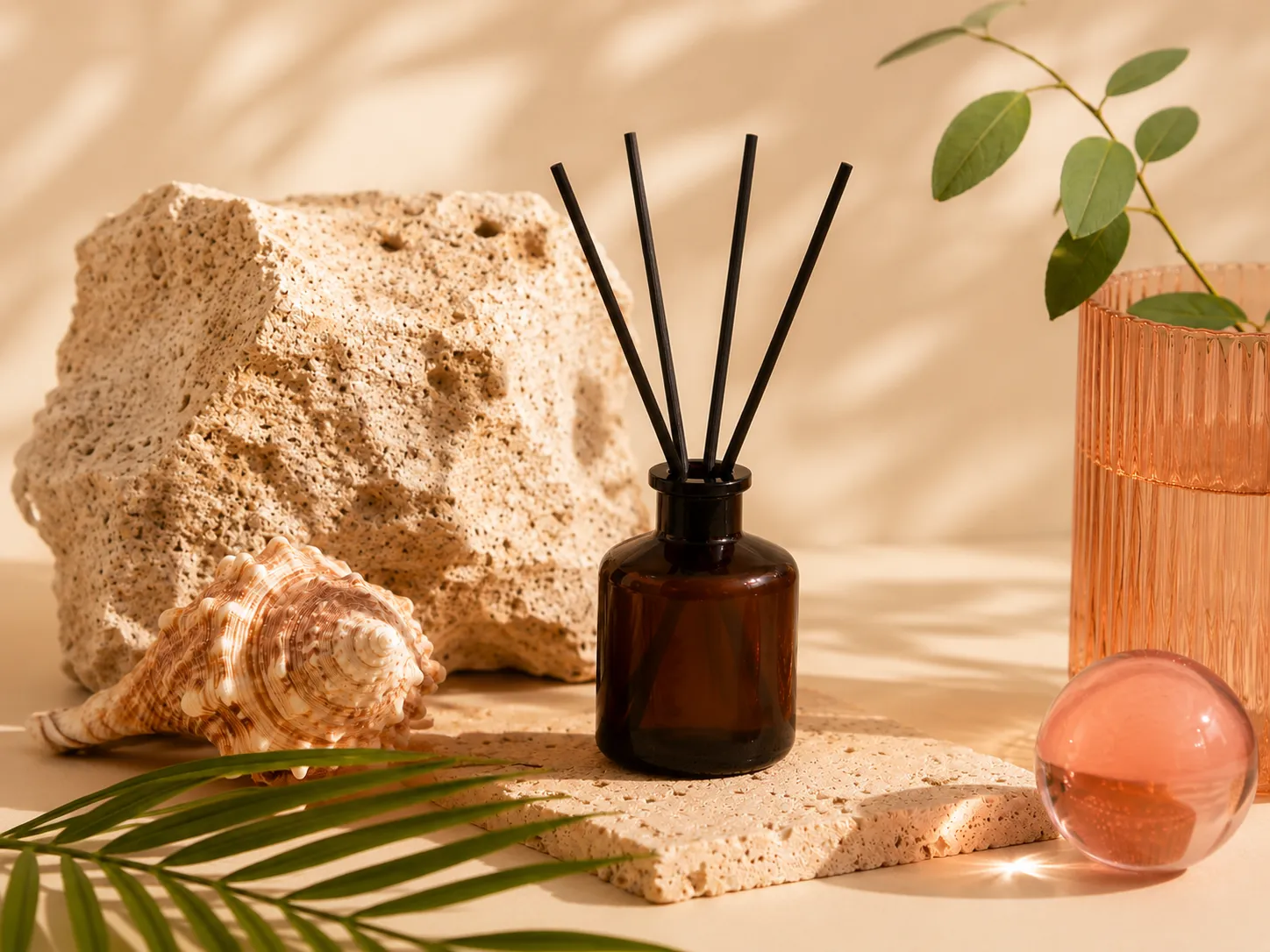
Reed diffusers are a solution that most people recognize intuitively: a bottle containing a fragrance liquid and several sticks (wooden, rattan, or synthetic) that absorb the fluid and slowly release it into the air. The mechanism is simple: scent spreads through the capillarity of the reeds and natural evaporation.
In practice, this means that reed diffusers:
-
Work locally: The strongest scent is noticeable in the immediate vicinity of the bottle, and its intensity decreases with distance and room size.
-
Perform well in small, enclosed spaces: Restrooms, small bathrooms, walk-in closets, small offices, backrooms, or compact entryway zones.
-
Are simple to operate: They require no electricity, configuration, or mobile apps; you simply set them up, occasionally flip the reeds, and replace the bottle periodically.
Their undeniable advantage is a low barrier to entry: you can quickly test different compositions while treating the scent as a decorative element. From a brand perspective, however, reed diffusers are more of a "fragrance product" than a scent branding tool. They signal that you care about the atmosphere, but it is difficult to build a consistent, scalable scent strategy around them in a larger space.
Reed Diffusers
They operate strictly on a localized, capillary basis, and their intensity declines over distance. They offer no precise controls and pose physical risks, such as furniture discoloration from accidental spills.
Cold Air Diffusers: Scent as Infrastructure, Not a Gadget
Cold air diffusion is a technology that clearly separates this type of diffuser from traditional home solutions like candles, reed diffusers, or sprays. Put simply: in a cold air diffuser, fragrance oil is broken down into microscopic particles (a dry mist) without using water or high heat. There is no burning, heating, or alcohol involved; the aroma is distributed in its pure form.
For brand-managed spaces, this offers several critical advantages:
-
Uniform coverage: The scent does not linger around a single piece of furniture. It covers the entire interior, even across larger square footage or open-space layouts.
-
Intensity and schedule control: The diffuser can be programmed (via schedules, modes, and power levels) so that the scent adapts to the flow of the day and human presence. It can operate differently in the morning than in the evening, or on event days versus quiet days.
-
Repeatability: The same fragrance composition will be perceived consistently across different areas of the space and over consecutive days, weeks, or events. This is the foundation of scent branding.
-
Safety and hygiene: Free of smoke, flames, paraffin, and aerosols. When using properly selected oils (such as IFRA-compliant compositions), this solution can be safely deployed where the comfort of sensitive individuals matters.
As a result, a cold air diffuser becomes part of the interior infrastructure, much like lighting or a sound system. It is not merely a "pretty object," but an operational tool for managing emotions and atmosphere: from the entrance and registration lines to service areas and showrooms.
Cold Air Diffusion and Oil Quality
Unlike traditional methods, cold air diffusion technology amplifies and exposes the composition of the fragrance. A low-quality oil will be noticed immediately, making it essential to use professional-grade essences (such as those provided by Solamé).
Reeds and Cold Air Diffusers in the Brand's Eyes: Different Roles, Different Outcomes
From the perspective of a brand manager or local business owner, it is best to view these two solutions not as competitors, but as tools for different tasks.
Reed Diffusers
-
Work well as a complementary accent in small areas that are difficult to connect to the main scenting system (restrooms, small private offices, micro-spaces).
-
Can serve a decorative role, matching brand aesthetics and accentuating details (e.g., on a product display shelf, in a foyer, or at a reception desk).
-
Offer a good "first step" if you want to test the direction of a scent composition before committing to a full-fledged diffusion system.
Cold Air Diffusers
-
Are the natural choice wherever scent is intended to be a core element of the brand experience rather than an afterthought: hotel lobbies, beauty salons, spas, showrooms, offices, boutiques, and event venues.
-
Enable you to build a signature scent in practice: a single scent signature can be experienced consistently throughout an entire space, and with the right technology, extended across multiple locations.
-
Provide an edge in experience management: you can actively control aroma intensity during events, peak hours, or intimate gatherings.
Viewed this way, the cold air diffuser is a strategic tool, while reed diffusers act as a tactical element that refines the details.
Home, Office, Boutique, Event: What Makes Sense Where?
Different space formats require different decisions:
Small, Enclosed Rooms
Reed diffusers are sufficient if the scent is meant to serve as a subtle, constant accent. However, remember that their intensity cannot be precisely controlled: in a tiny room, they may feel overwhelming, while in a larger room, they might disappear almost completely.
Medium and Large Interiors, Open Spaces, Event Venues
Cold air diffusers win convincingly here. They allow you to cover the entire space with scent and extend your signature scent to every touchpoint where the brand meets the audience. For events, control capabilities are especially crucial: you scent the space differently during setup, keynotes, networking sessions, or after-parties.
Small Local Businesses
A cold air diffuser lets you build a professional scent experience even on limited square footage: boutiques, studios, order pickup points, or product showrooms. Reed diffusers can support this experience, but primarily as decorative accents on product displays, in fitting room micro-zones, or at the counter.
If you treat scent as part of your branding rather than a simple air freshener, a cold air diffuser provides the foundation to build your strategy on. Reed diffusers can then fulfill a minor, aesthetic support role.
Flexibility and Control in Cold Air Diffusion
Cold air diffusers offer full programmability (schedules, intensity settings, operating modes), allowing you to align the scent with the daily rhythm, foot traffic, and volume of the space.
Safety, Hygiene, and Guest Comfort
When managing a brand space, you are responsible not only for the visual and communicative impact, but also for the physical comfort of the people inside. When it comes to scent, several practical factors should be considered:
-
Intensity control: Reed diffusers offer very limited adjustments; you can only alter the number of sticks or flip them, which is imprecise. Cold air diffusers allow you to set specific parameters (power level, operating times, pause intervals), which is vital during high foot traffic or for diverse audiences.
-
Physical safety: No flames, no smoke, and no aerosols: a properly configured cold air diffuser is extremely safe for daily use. While simple, reed diffusers require careful placement to avoid tipping over, contact with children or pets, or surface stains from spilled liquid.
-
Composition quality: Regardless of the technology, ingredients matter: professional oils compliant with industry standards vs. cheap, harsh mixtures of unknown origin. Cold air diffusion makes oil quality especially noticeable, as the technology does not mask the composition, but highlights it.
A conscious approach to these matters protects people's well-being while strengthening a responsible brand image.
How to Decide: A Simple Framework for Brands
Looking at the big picture, your choice between reed diffusers and cold air diffusers can be guided by a few key questions:
-
What role should the scent play?
-
If it is a decorative element and light accent: reed diffusers are enough.
-
If it is an integral part of brand identity and experience: you need a cold air diffuser.
-
-
How large and critical is the space?
-
Small, auxiliary zones: reed diffusers provide a simple, localized effect.
-
Core brand spaces (reception, showroom, main hall, event floor): a cold air diffuser serves as your scent branding engine.
-
-
Does the scent need to perform consistently over time?
-
One-off, occasional use: reed diffusers can handle the job.
-
Long-term, daily scent experience: a cold air diffuser guarantees repeatability and control.
-
-
Is scalability important?
-
Single venue, small space: you can start with a hybrid approach (cold air diffuser as the base + reed diffusers for details).
-
Multiple locations, complex event setups: cold air diffusion makes it seamless to replicate your signature scent across sites.
-
Scalability of Identity
A true signature scent requires consistency. Only advanced technology allows you to precisely clone the exact same scent experience across multiple company locations.
From Technology Selection to Brand Experience: The Role of Solamé Studio
Our role goes beyond selecting a fragrance composition; we design how that scent lives in your space, including the chosen technology, intensity levels, and operational scenarios.
That is why in many projects we recommend cold air diffusers as the foundation for scent branding in key spaces and events. We treat reed diffusers as a complementary element: applied where their limitations do not interfere, and where their aesthetic qualities support the interior design.
If you want your space to smell as cohesive as it looks, sounds, and communicates, selecting the right scent technology is a crucial step. A well-designed diffusion setup can do more for your brand than another banner or commercial: it simply embeds the experience in people's memories on a level that other stimuli struggle to reach.
About the Author

Weronika Barnat
Brand & Scent Branding Strategist
For over 10 years, I have been helping brands build a competitive edge through strategy, communication, and customer experience. At Solame, I combine branding with the power of scent, designing solutions that engage emotions, enhance recognition, and make brands stay in memory longer.

Scent Marketing in a Hotel: How Scent Affects the Guest Experience

How to leverage scent in event marketing?

Scent as an element of brand equity: How to measure its real impact on the brand

Why Do We Remember Scent and Not Ads? The Psychology of Scent Branding in Solame’s Practice
The future of branding engages all the senses.
Let's create an experience as unique as your brand.
Get in Touch
668 307 119
798 234 260
hello@solame.pl
ul. Basztowa 23/5, 31-156 Kraków
Quick Links
Offer
Scented Merchandise
Who We Work With
About Us